
Read Wayne County Property Tax Records by Source
Property Valuation Administrator handles the valuation side, while the Sheriff collects the county tax bills. Delinquent accounts eventually land with the County Clerk. Keep the roles straight. A paid bill proves nothing about who holds title, and an assessment figure is not the amount currently due.
| Field | What It Shows | Where |
|---|---|---|
| Land and improvement values | Separate assessed components and Total FCV | PVA qPublic card |
| Exemption and taxable values | Excluded value and remaining tax base | PVA qPublic card |
| Owner and assessment year | Owner as of the Kentucky assessment date | PVA roll |
| Tax bill and status | County account used for collection | Sheriff Properly Tax |
| Delinquent account | Later-stage certificate or claim information | County Clerk |
The tax roll establishes the base for taxation. District rates, exemptions, and the bill year all shape what the Sheriff ultimately collects. A recorded consideration in the deed records is a separate figure entirely. It may reflect a gift, a partial interest, or a nominal amount rather than a true market sale. Never read it as a price.
Save a copy of every result with its date. The assessment year, the bill year, and the deed recording date can point to three different moments in time. That is easy to miss. A parcel that sold after January 1 often still shows the prior owner of record on that year's tax roll. The Clerk may already hold the newer conveyance. That lag is routine. Document it first, though, or a payment question may go to the wrong office.
Trace a Wayne County Tax Bill from Address to Payment
Start with the Wayne County qPublic search, where the basic search is free and returns ownership plus assessed value. A typical report breaks out the Parcel Number, Account Number, Location Address, owner, Tax District, and value lines, along with a View Map link. Write those identifiers down. The collector will need them next.
- Search qPublic by location address, owner, or parcel and confirm the tax year.
- Copy the parcel number, account number, tax district, and exact owner label.
- Open the Sheriff Properly Tax lookup and match the correct bill.
- Read payment or delinquency information only after confirming the parcel and year.
- Assessed value
- The PVA's fair-cash-value measure used in tax administration.
- Rate or levy
- The rate applied by the relevant taxing district.
- Homestead exemption
- A qualifying reduction in taxable value, not proof of title.
- Tax lien
- A claim tied to unpaid taxes that requires current office confirmation.
The portal capture below comes from the official Wayne County tax-bill endpoint.
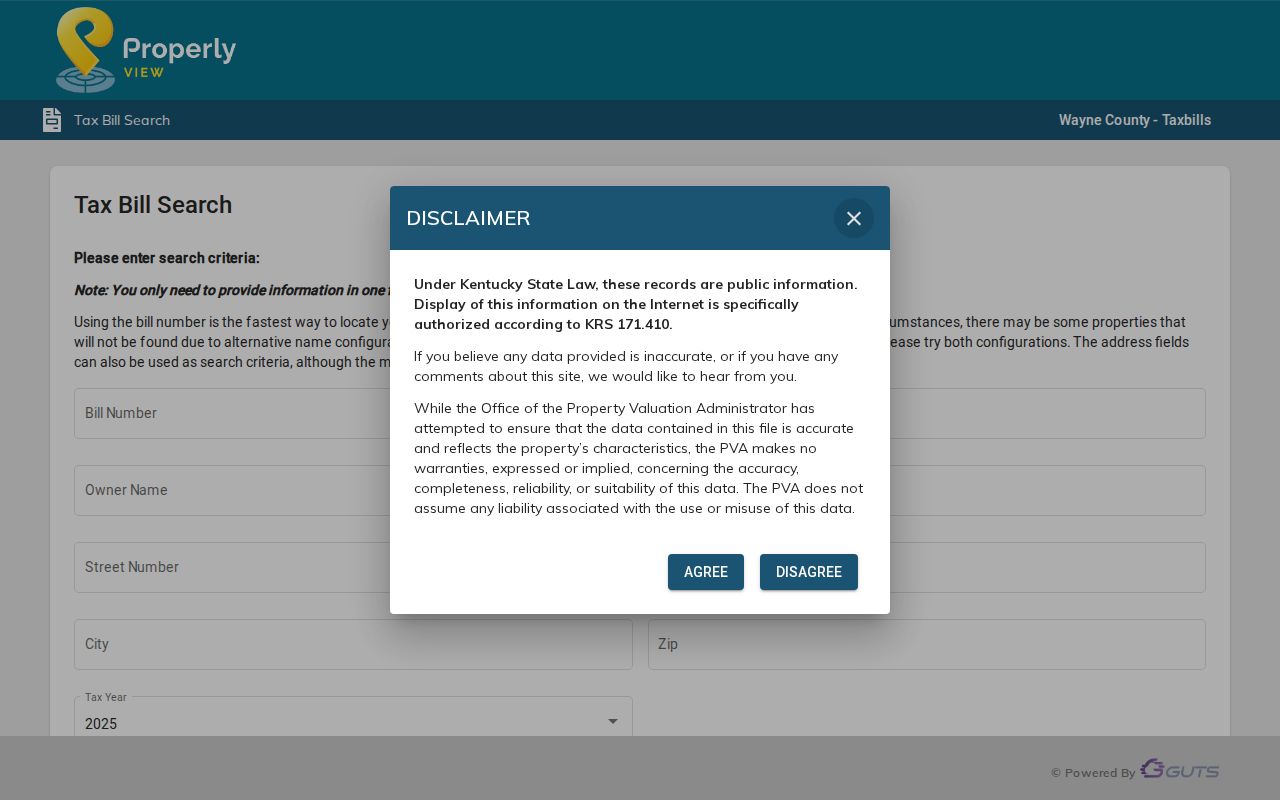
The collector's site confirms how payment is accepted. Field order, year range, and processing fees can change, so confirm those details live before submitting any money.
Contest a Wayne County Assessment on the State Calendar
A Wayne County assessment challenge runs on the state calendar. Request a conference with the PVA. Do it during the 13-day public inspection period that opens the first Monday in May. No resolution there means an appeal to the local Board of Assessment Appeals. The PVA requires that form no later than one workday after inspection ends. From there, a further appeal generally reaches the Kentucky Board of Tax Appeals. This must come within 30 days of the local decision. Check the current Kentucky calendar before each deadline.
Appeal window. Confirm the year's inspection close and filing form before the last day; value evidence cannot cure a missed deadline.
January 1 Explains Wayne County Tax-Record Lag
Kentucky assesses property as of January 1. A Wayne County property tax bill can therefore retain a prior owner after a later closing or show a bill in care of a new owner. That is a timing rule, not proof of current title. For a recent sale, compare the roll with the latest County Clerk deed.
The PVA may revalue property annually and physically examines real property at least once every four years. That cycle measures property characteristics; it is not a promise that every new deed appears on qPublic within a fixed number of days.
Note: Wayne County publishes no verified average refresh lag, so use the deed recording date instead of assuming a 30, 60, or 90-day update.
Wayne County Fair Cash Value and Taxable Value
Kentucky law assesses property at 100 percent of fair cash value. The Department of Revenue assessment process lays out the approaches behind that figure. It covers the sales-comparison, cost, and income approaches. A Wayne County report typically shows several lines. These include Land Value, Improvement Value, Ag Improvement Value, Total FCV, Exemption Value, Net Taxable Value, and a certified value history. Treat Total FCV and Total Taxable Value as distinct numbers. Check the current card's exemption treatment and assessment year carefully. Neither figure is a private appraisal or a forecast of what a buyer will pay.
Wayne County's Current Homestead Exemption
The 2025-26 Kentucky homestead exemption stands at $49,100. To qualify, an owner must be at least 65 or totally disabled. The property must serve as their maintained personal residence on January 1. Applications go through the Wayne PVA, whose local materials spell out the required age and disability proof and whose downloadable forms cover both exemption and correction routes. Remember that the exemption touches the tax calculation only, never ownership. Past amounts were $46,350 for 2023-24, $40,500 for 2021-22, and $39,300 for 2019-20, so match the year before comparing.
Follow Delinquent Wayne County Property Tax Accounts
Collection begins with the Sheriff. The Wayne County Clerk delinquent-tax page covers what happens after an account goes unpaid. However, the county publishes no complete current tax-sale calendar. Ask staff directly for the parcel, bill year, certificate or claim status, payoff date, and any added charges. Do not trust an old list.
When an online search comes up empty, reach the Sheriff by phone or in person. For a non-indexed list, a focused Kentucky Open Records Act request can name the parcel and years. It can also specify the format and date range. Keep the ask narrow. Staff cannot be expected to build a new analysis from scratch.
Cross-Check Monticello City Property Tax Records
Monticello keeps its own city property-tax search. It has fields for Year, Bill Number, Map Number, Service Address, and Name or Owner. That makes it easy to test whether a parcel carries a city bill in addition to the county one. Treat it as a supplement. The Wayne PVA roll and the Sheriff's county account remain the records of authority.
Audit a Wayne County Property Tax Record Before Relying on It
Before trusting any Wayne County property tax record, capture the details that identify it: the parcel number, bill year, assessment year, owner label, tax district, exemption, and every value field. Compare the location address rather than matching on a common surname alone. If the parcel has split, merged, or changed account numbers, ask the PVA to identify the parent and successor records first. Comparing bills across that break will mislead you otherwise.
Each error has its own fix, and they do not interchange. A correction or exoneration form addresses PVA data. Payment and payoff questions belong to the Sheriff. A deed correction belongs with the Clerk. State the exact field in dispute and bring the source that conflicts with it, whether a deed, survey, photographs, cost evidence, or a prior card.
For older tax context, KDLA holds Wayne assessment books in numerous runs beginning in 1801, with gaps. Archive research costs and timelines sit apart from county service. A historic assessment proves nothing about today's value or current liability.