
What Wayne County Deed Records Convey
The Wayne County Clerk is the office that records instruments affecting land. A properly prepared deed names the grantor and grantee. It gives mailing addresses and consideration. It also carries a full legal description with the source of title. The deed lists the preparer and the return address. An in-care-of tax-bill address appears where required, along with notarized signatures. The instrument type tells you what interest moved and which assurances came with it.
| Deed Type | What It Does | Common Use |
|---|---|---|
| General warranty deed | Conveys the described interest with broad title covenants | Ordinary arms-length conveyance |
| Quitclaim deed | Conveys only the interest the grantor may possess | Interest cleanup or intra-family transfer |
| Correction deed | Corrects the cited original without a new conveyance | Name, wording, or description correction |
| Commissioner's deed | Conveys under court-authorized process | Judicial or foreclosure-related sale |
| Executor or will transfer | Moves an estate interest with probate references | Distribution after death |
Not every recorded document names a new owner. A mortgage, assignment, release, lis pendens, or tax lien can change a parcel's standing while leaving the owner of record in place. Sort conveyances from encumbrances before you build a chain of title.
Use Wayne's Public Land-Record Credentials
The Clerk's online-records page points the public to waynecountyky.com. It notes that documents are free to view. It also supplies the lowercase credentials public/public. The page itself does not state the portal's earliest year, its search tabs, dropdown menus, pagination, or certified-copy fees. So treat it as an entry point rather than a full manual. Search both sides of every transaction. Record the party role, document type, recording date, book or instrument reference, legal description, and consideration when indexed. Add any prior-deed citation as well. Note whether an image opens. Not every result will display every field. Expect variation from one record to the next.
Wayne County Recording Details Prevent False Matches
A shared surname proves nothing about two deeds covering the same land. Compare full party strings and the Clerk-required description. Check the source of title. Verify the parcel address and any earlier book and page reference before linking records. A correction deed should cite the original instrument and state exactly what it corrects. An easement gets indexed by parties and affected parcels. It conveys a land right, not the fee estate itself.
Affidavits of descent or heirship can name a decedent, spouse, heirs, relationships, and their interests. Transfers under a will connect the personal representative with the recipient and a will-book reference. A lis pendens signals live litigation. Read the court action and its final disposition before deciding what actually happened.
DOCALERT Adds a Wayne Name-Monitoring Route
The Clerk links free DOCALERT registration so a personal or business name can be watched. It works well for catching newly indexed deeds and mortgages. Still, it tracks names, not parcels. Register every relevant spelling or entity variation. Then pull and read any alerted document. The official registration page serves as the Wayne County deed-record monitoring entry point.
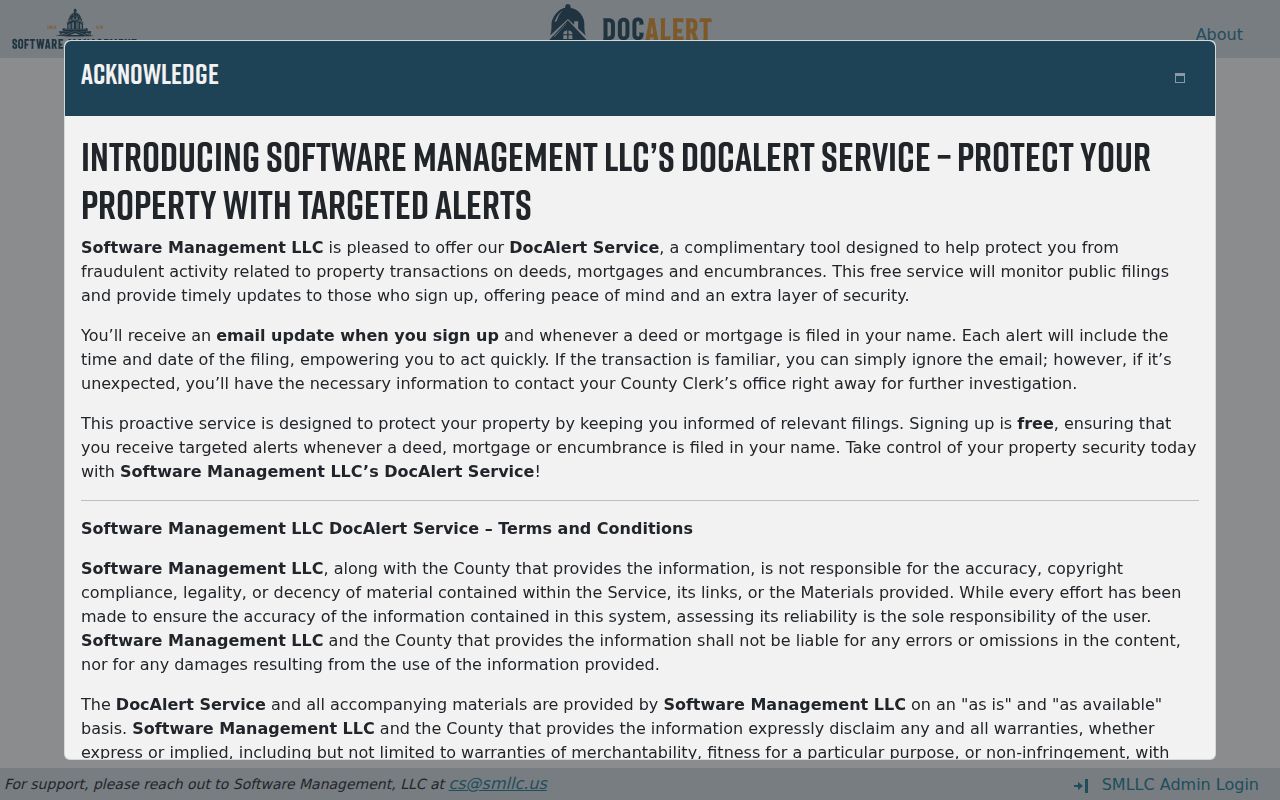
Treat an alert as a prompt, not a verdict. Read the instrument and verify its parcel and parties before assuming a filing is fraudulent or valid.
Walk Wayne's Grantor-Grantee Index Backward
Start with the current parcel in qPublic. Then move to the Clerk's index for the recorded chain. Before switching systems, copy the exact owner name, parcel and account numbers, legal-description clues, and any deed reference already in view.
- Find the present owner as grantee and select the newest conveyance matching the land.
- Read the grantor, recording date, document reference, description, and cited source deed.
- Search that grantor as an earlier grantee; repeat while comparing the same tract at every transfer.
- Branch into probate, commissioner, correction, or court records when the chain does not pass through an ordinary deed.
- Continue in deed books, microfilm, and general indexes when the live portal stops.
- Grantor
- The party conveying the stated interest.
- Grantee
- The party receiving that interest.
- Chain of title
- The linked sequence of instruments for the same land.
- Book/page or instrument number
- A recorded-document reference, distinct from parcel and account numbers.
Historic Wayne Deed Books Begin in 1801
The FamilySearch Wayne catalog lists deed books covering 1801 through 1901. General indexes begin in 1799/1800 and run to 1920. Those index volumes overlap slightly at their edges. When a date falls near a boundary, search the neighboring volume too. A separate commissioners' deed catalog covers 1877 through 1935. It notes that volume two has no index. The catalog page is a finding aid, not a deed copy.
Use the year and volume clues to find an image or microfilm reel. When certification is required, confirm the instrument with the Clerk.
KDLA Extends the Wayne Record Trail Through 2011
The Kentucky Department for Libraries and Archives keeps a land inventory. It lists Wayne deed microfilm running from 1801 through 2011. Do not confuse that confirmed range with the Clerk portal's unstated cutoff. KDLA accepts archival research requests at $20 in-state and $25 out-of-state. The estimate runs four to six weeks. Copy, scan, or postage costs may add on.
FamilySearch access varies by item. Some items may call for an account or a visit to a FamilySearch Center. The Wayne County Historical Society adds family files, obituaries, census sources, and local histories. These can explain a name change or an estate shift. Treat all of it as clues. Each one should lead back to a recorded deed, probate instrument, or court order.
The 1898 Wayne Courthouse Event Requires Care
KDLA's courthouse-disaster inventory lists an approximate 1898 event in Wayne County. That does not mean every deed from the period vanished. When a chain link goes cold, compare the surviving records. Check the general indexes, deed books, and tax books. Court orders, commissioners' deeds, and later instruments reciting a source of title also help.
The Monticello Outlook catalog begins in 1904 and can surface sheriff's-sale, estate, and property-notice leads. Historic newspapers and family files can explain a transition. They never replace the instrument itself. Test name variants, initials, married names, estates, and old place labels like Mill Springs.
Obtain a Wayne County Deed Copy
Start with the free online index, where many Wayne County deed records appear as images. Older volumes and certified copies still require the Clerk, as do documents never posted online. That means the Wayne County Clerk. Visit 55 N Main Street, Suite 106, Monticello, Kentucky 42633, or call 606-348-5721. Posted hours are Monday through Friday, 8:00–4:30, plus the third Saturday, 8:00–noon. Verify before traveling.
Details speed the request. Provide the grantor and grantee names, the approximate recording date, the document type, and a book/page or instrument number. Ask the Clerk about copy and certification fees, since prices are not posted. For archive-scale work, FamilySearch and KDLA hold major collections. An open-records request should name an existing record rather than ask an office to build a title report.
Recorded, not guaranteed. The Wayne County deed index shows filed instruments, not a title opinion. Unrecorded rights, partial interests, unresolved litigation, or description conflicts may require professional title review.
Read Consideration Without Calling It Market Value
Consideration is not market value. Kentucky deed and transfer-tax rules allow consideration or fair-cash-value language in a conveyance. The recorded figure may instead reflect a gift. It may be a nominal amount, an exempt transfer, a partial interest, or an affidavit. None of that equals a sale price. When value is the real question, compare the deed against the PVA's assessment fields. An independent appraisal helps too.
Quitclaim deeds deserve equal caution. A quitclaim passes only the interest the grantor actually holds. It cannot repair an uncertain chain of title. A mortgage assignment likewise swaps the lien holder without necessarily changing who owns the land. Careful classification keeps Wayne County deed records from being read as something they are not.
When the Wayne Deed Chain Branches
Branching chains are common here. A parcel assembled from several tracts can trace back to more than one source deed. Follow each legal-description branch on its own. When the next owner arrived through an estate, commissioner sale, affidavit, or correction, chase the cited court, probate, or original deed reference before moving further back.
Names can hide a deed too. Search initials, full names, married-name variants, and entity punctuation, and reject any hit whose land description does not match. Court-connected instruments need another stop. Kentucky CourtNet offers a public case-information starting point, while the Wayne Circuit Clerk keeps the local file and issues certified copies; a docket snapshot, like a deed index, only points the way, and the underlying order and final disposition carry the legal effect.